
Naismith's Rule vs Real Hiking Speeds: A Data Study
How accurate is Naismith's rule? Tested against Tobler's hiking function and Langmuir's corrections across 10 gradients — charted and sourced.
In this guide
Quick answer: Naismith’s rule is nearly perfect on flat ground — about 5 km/h, exactly where Tobler’s function lands too. It falls apart in two places: on climbs of 5–15°, it predicts speeds 27–35% slower than Tobler’s empirically fitted curve, and on descents it predicts no speed change at all. Every number below is computed directly from the published formulas, and the full methodology is at the bottom of this page.
The three contenders
Three formulas have dominated hiking-time estimation for over a century, and they all get cited in guidebooks, route planners, and forum arguments:
- Naismith’s rule (1892). Scottish mountaineer William W. Naismith’s famous rule of thumb: allow one hour for every 3 miles of distance, plus one hour for every 2,000 feet of ascent. In metric terms, that’s roughly 5 km/h plus 10 minutes per 100 m climbed. Its famous weakness: it says nothing about descents.
- Langmuir’s corrections (1984). Eric Langmuir extended Naismith to downhills: subtract 10 minutes per 300 m of descent on gentle declines (5–12°), and add 10 minutes per 300 m on steeper declines (over 12°).
- Tobler’s hiking function (1993). Geographer Waldo Tobler fitted an exponential function to empirical walking data: W = 6e^(−3.5|S+0.05|), where S is the slope. It predicts ~5 km/h on flat ground and peaks at 6 km/h on a mild descent of about 3°.
The experiment
We took each formula at face value and computed the predicted speed over a 1 km horizontal segment at ten slope angles, from a −30° plunge to a +30° grind. Gradient converts to climb/descend per kilometre via tan(θ). No fitness factors, no weather, no pack weight — just the raw formulas, exactly as published.
The data
| Slope | Naismith | Langmuir-corrected | Tobler |
|---|---|---|---|
| −30° | 5.00 km/h | 1.92 km/h | 0.95 km/h |
| −15° | 5.00 km/h | 2.87 km/h | 2.80 km/h |
| −10° | 5.00 km/h | 9.80 km/h | 3.86 km/h |
| −5° | 5.00 km/h | 6.61 km/h | 5.26 km/h |
| 0° (flat) | 5.00 km/h | 5.00 km/h | 5.04 km/h |
| +5° | 2.89 km/h | 2.89 km/h | 3.71 km/h |
| +10° | 2.02 km/h | 2.02 km/h | 2.72 km/h |
| +15° | 1.55 km/h | 1.55 km/h | 1.97 km/h |
| +20° | 1.24 km/h | 1.24 km/h | 1.41 km/h |
| +30° | 0.86 km/h | 0.86 km/h | 0.67 km/h |
All speeds in km/h over a 1 km horizontal segment. Computed from the formulas as published — see methodology.
The chart
What the numbers say
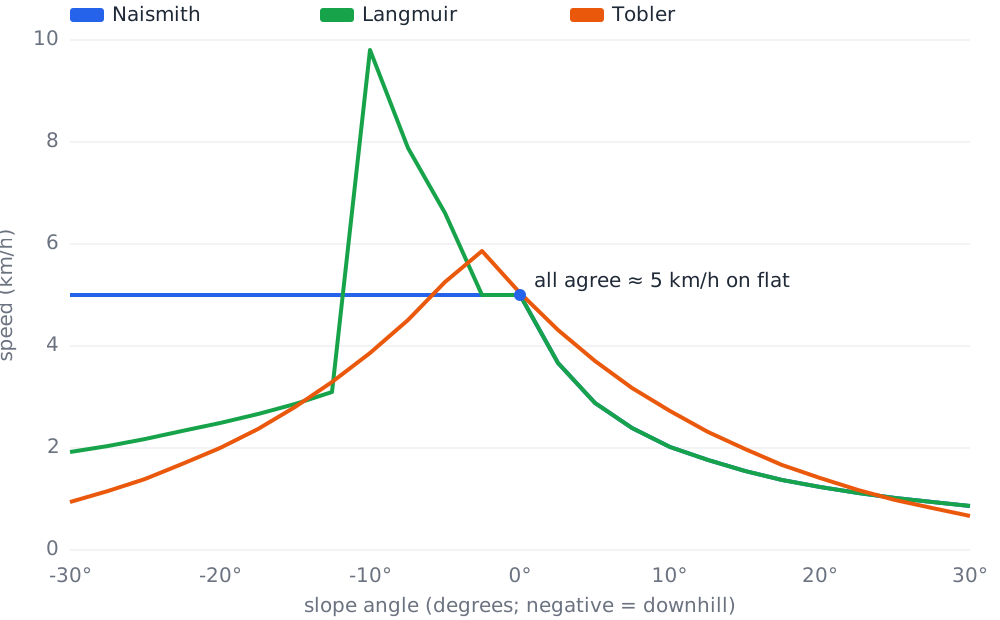
1. Everyone agrees on flat ground. Naismith, Langmuir, and Tobler all land at ~5 km/h on the flat. The most famous number in hiking is also the least controversial.
2. Naismith is pessimistic on moderate climbs. Between +5° and +15°, Naismith predicts speeds 27–35% slower than Tobler’s curve (2.89 vs 3.71 km/h at +5°; 1.55 vs 1.97 at +15°). Tobler’s function was fitted to real empirical walking data, so on sustained climbs the 1892 rule likely overestimates your time.
3. Langmuir’s descent bonus is the outlier. The gentle-descent correction predicts 6.6 km/h at −5° and a physically absurd 9.8 km/h at −10° — faster than elite downhill hiking pace on smooth trail. The correction flips discontinuously at 12° (from −10 min to +10 min per 300 m), which is why the curve jumps. This is the known bug in the Langmuir patch, and the numbers make it visible.
4. Descents remain the weakest link. Naismith predicts 5 km/h downhill no matter how steep — its documented limitation. Tobler handles descents smoothly, which is why route-planning software overwhelmingly uses it.
5. Past +20° uphill, Naismith becomes the optimist. The two curves cross near +20°; at +30°, Naismith predicts 0.86 km/h vs Tobler’s 0.67 km/h. On genuinely steep ground both are guesses — neither formula was validated there.
What the big GPS studies found
Formulas are one thing; hundreds of thousands of kilometres of GPS tracks are another:
- Wood et al. (2023), PLOS ONE — tested the classic rules against roughly 88,000 km of UK hiking GPS tracks. Their new model beat every established function on error, and the key finding was what the old rules miss: the hill slope (terrain gradient regardless of which direction you’re walking) and terrain obstruction both significantly affect speed. Prediction error between the new model and the old rules grows as hill slope increases.
- Campbell et al. (2019) — measured slope and travel rates experimentally and against GPS data from nearly 30,000 individuals (~1.1 million data points), then built flexible speed functions spanning the 1st to 99th percentile of hikers — a reminder that “average” speed hides enormous individual variation.
The takeaway for trip planning: use Tobler-based estimates as your baseline, then tune for yourself. Fitness, pack weight, trail surface, and group size move the needle more than the choice of formula. Our free hiking time estimator gives you a fast Naismith-based starting point, and our guide to training for a multi-day hike helps close the gap between formula and reality.
Methodology
- Computation: For each slope angle θ, horizontal segment = 1 km. Climb/descend = 1000 × tan(θ) metres.
- Naismith: time = 12 min per km + 10 min per 100 m of ascent (metric equivalent of 1 h per 3 mi + 1 h per 2,000 ft). Descents: no adjustment (flat speed), per the original rule.
- Langmuir: Naismith base + (−10 min per 300 m descent for 5–12° declines; +10 min per 300 m descent for declines over 12°).
- Tobler: W = 6e^(−3.5|S+0.05|), S = tan(θ). On-path version (no 0.6 off-road factor).
- Not modelled: fitness, fatigue, pack weight, altitude, weather, trail surface, navigation stops. All speeds are steady-state predictions, not trip averages.
- Reproducibility: the table above can be regenerated from the formulas in the Sources section with a pocket calculator; the chart SVG is generated from the same numbers.
Sources
- Naismith’s rule (1892), Aitken’s corrections (1977), Langmuir’s corrections (1984) — formula statements: https://en.wikipedia.org/wiki/Naismith%27s_Rule
- Tobler’s hiking function (1993), W = 6e^(−3.5|S+0.05|), fitted to Eduard Imhof’s empirical data: https://en.wikipedia.org/wiki/Tobler%27s_hiking_function
- Wood A. et al. (2023), “Improved prediction of hiking speeds using a data driven approach,” PLOS ONE (~88,000 km of GPS tracks): https://journals.plos.org/plosone/article?id=10.1371/journal.pone.0295848
- Campbell et al. (2019), slope/travel-rate study (~30,000 individuals, ~1.1M data points), summary: http://www.sciencedaily.com/releases/2019/04/190403101108.htm
Share this chart
Bloggers and journalists: you’re welcome to reuse the chart above with attribution. Copy and paste this snippet:
<a href="https://trailtested.pages.dev/trails/naismith-rule-hiking-speed-study/">
  <img src="https://trailtested.pages.dev/images/naismith-speed-chart.svg"
       alt="Chart: Naismith vs Langmuir vs Tobler hiking speed predictions by slope angle"
       width="1000" />
</a>
<p><em>Chart: <a href="https://trailtested.pages.dev/trails/naismith-rule-hiking-speed-study/">Trail Tested — Naismith's Rule vs Real Hiking Speeds: A Data Study</a></em></p>
Planning a trip? Run your route through the hiking time estimator, check your load with the pack weight calculator, and read how to train for a multi-day hike.
Frequently asked questions
How accurate is Naismith's rule?
On flat ground it’s excellent — it predicts about 5 km/h, matching Tobler’s function almost exactly. On climbs between 5 and 15 degrees it predicts speeds 27–35% slower than Tobler’s empirically fitted function, and on descents it predicts no change at all, which is its most criticized weakness.
What is Tobler's hiking function?
An exponential function formulated by geographer Waldo Tobler in 1993 (W = 6e^(−3.5|S+0.05|)) that estimates hiking speed from terrain slope. It predicts about 5 km/h on flat ground and up to 6 km/h on gentle descents, and it adapts smoothly to slope instead of treating climbs and descents as separate cases.
What are Langmuir's corrections to Naismith's rule?
Eric Langmuir (1984) extended Naismith’s rule to descents: subtract 10 minutes per 300 m of descent on gentle declines (5–12°), add 10 minutes per 300 m on steeper declines. Our computation shows the gentle-descent bonus predicts an unrealistic 9.8 km/h at −10° — faster than anyone actually hikes downhill.
Which hiking time formula should I use?
For quick planning, Naismith’s rule is fine on gentle terrain. For route software and serious planning, Tobler’s function is the better-supported choice — it handles slopes continuously and was fitted to empirical data. Always adjust for your own fitness, pack weight, and terrain, and try our free hiking time estimator for a fast answer.
Do modern GPS studies agree with Naismith's rule?
Partially. A 2023 PLOS ONE study tested the classic rules against roughly 88,000 km of UK hiking GPS tracks and found they miss two significant factors: the hill slope (terrain gradient regardless of walking direction) and terrain obstruction — with prediction error growing on steeper terrain.