
How to Hike at Night Safely: Beginner's Guide (2026)
Night hiking is safe when you're prepared: the right headlamp, a familiar trail, smart pacing, and a bail-out plan. A beginner's guide to hiking after dark.
In this guide
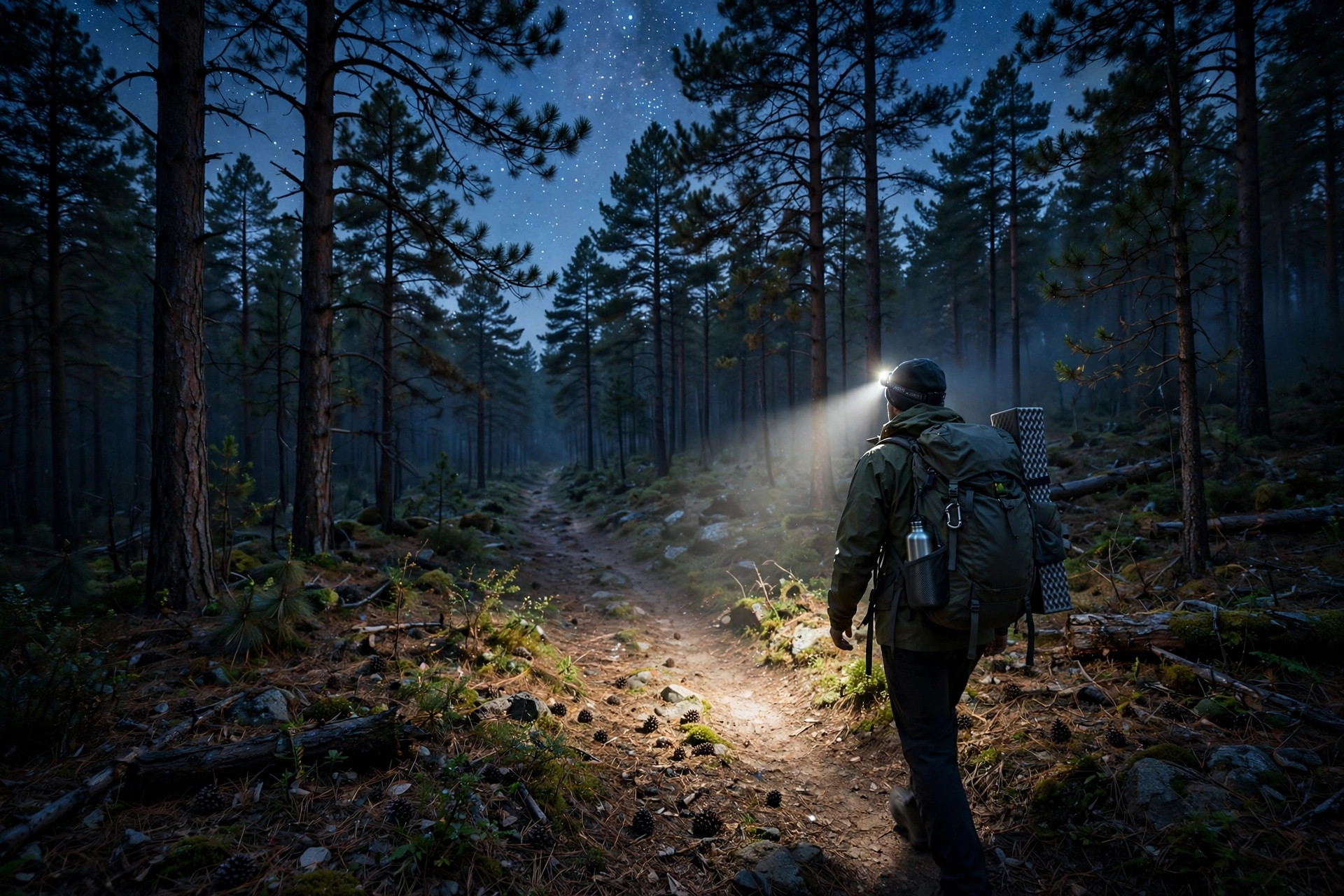
In October, the sun sets around 6:30 PM in much of the US — and every year, thousands of day hikers learn that a “quick afternoon loop” can end in the dark. Night hiking sounds intimidating, but with a decent headlamp, a trail you know, and a few technique adjustments, hiking after dark is not only safe, it’s genuinely magical: empty trails, owls calling, stars you never see from a trailhead at noon.
Some hikers even plan for it: full-moon hikes and summit sunrises are some of the most memorable nights you can have on trail. This guide covers both scenarios — night hiking on purpose, and the accidental after-dark finish — because the skills are the same either way.
Quick answer: Hike a trail you already know in daylight, start with sunset so your eyes adjust gradually, carry a headlamp plus a backup light and spare batteries, dress for temperatures 10–20°F colder than the daytime high, slow your pace, stay on marked trails, make some noise, and tell someone your plan. If you lose the trail, stop and backtrack — never bushwhack in the dark.
A note on sources: This guide is research-compiled from widely repeated night-hiking practices, headlamp manufacturer guidance, and outdoor-education resources. It is not a lab-tested equipment review, and night-hiking regulations vary — always check whether your trail or park allows after-dark use before you go.
Why the dark changes everything (and nothing)
Your trail legs don’t care what time it is. But your senses do:
- Your vision narrows. Headlamp beams create tunnel vision — you see a bright cone and lose the periphery where trail junctions, blazes, and drop-offs live. Expect to navigate more deliberately.
- Depth perception gets worse. Roots, rocks, and dips flatten out under artificial light. Ankle-twisters you step over casually at noon become real hazards at night.
- Everything takes longer. Most hikers move 20–30% slower in the dark. Plan your time accordingly — the mile that took 25 minutes at 4 PM takes 35 at 9 PM.
- Temperatures drop fast. The hour after sunset often brings the steepest temperature fall of the day. Sweaty from the climb up + cold night air is the classic recipe for getting chilled.
- Wildlife changes shifts. Dawn and dusk are peak animal activity, and many animals are simply more active at night. That’s mostly a feature (owl encounters), not a threat — but it means making noise and staying alert matters more.
None of this is a reason to fear the dark. It’s a reason to respect it and adjust.
Before you go: the night-hike plan
Most night-hiking problems are planning problems, not darkness problems. Handle these in daylight:
- Hike a trail you know. Your first night hike should never be your first time on a trail. Familiar junctions, familiar footing, familiar bail-out points — in the dark, familiarity is safety.
- Check the moon. A full or near-full moon on open terrain can be bright enough to hike with your headlamp off for stretches. A new moon in dense forest is a different sport. Either is fine; just know which you’re getting.
- Check the weather and the sunset time. Know exactly when civil twilight ends where you’re hiking. If storms are possible, night is the wrong time to learn that lesson.
- Tell someone your plan. Route, trailhead, expected return time, and when to worry. This is always important; in the dark it’s non-negotiable.
- Verify night access. Some parks and trailheads close at sunset or prohibit after-dark use. A locked gate at the trailhead parking lot is a bad way to start.
The headlamp: your most important decision
A headlamp is the one piece of gear that makes or breaks a night hike. Here’s what actually matters, research-compiled from manufacturer guidance and long-distance hiker practice:
- 100–300 lumens is the sweet spot for trail hiking. Enough to read the trail surface and catch blazes 30–50 feet ahead. Ultra-bright 1000-lumen modes mostly just kill your battery and bounce blinding glare off nearby leaves.
- Red-light mode is not a gimmick. White light destroys your night vision for 20+ minutes; red light preserves most of it. Use red for camp tasks, map checks, and chatting at rest stops — save white for moving.
- Battery life beats max brightness. A lamp that runs 8 hours at a usable 150 lumens beats one that does 1000 lumens for 90 minutes. Check the runtime specs at the brightness you’ll actually use.
- Carry a backup. Spare batteries at minimum; a second light (even a tiny keychain light or your phone) is better. The single most common night-hiking emergency is a dead headlamp.
- Test it before the trail. Check brightness modes, the tilt angle, and the headband fit at home. Fumbling with an unfamiliar interface in the dark is avoidable.
One more tip: wear the headlamp over a beanie or hat in cold weather — it stays put better and the band doesn’t freeze-sweat against your forehead.
On the trail: night-hiking technique
The trail is the same. Your technique shouldn’t be:
Let your eyes adjust. Give yourself 20–30 minutes in dimming light before full darkness. Starting a hike at sunset and walking into the night is far easier than stepping out of a car into pitch black at 10 PM.
Look ahead, not down. Beginners stare at the bright pool of light at their feet. Force your gaze 10–15 feet ahead — that’s where the trail is going, and your feet handle the near ground better than you think.
Slow down and shorten your stride. This isn’t a fitness hike. A deliberate pace with shorter steps keeps you balanced over uneven ground you can’t fully see. Trekking poles earn their keep at night.
Navigate actively. Check off landmarks and junctions as you go. In daylight you navigate passively by sight; at night, confirm your position at every junction. A quick glance at your map or GPS app at each turn takes ten seconds and prevents the classic “we’ve been walking the wrong way for twenty minutes.”
Stay on marked trails. Night is not the time for off-trail exploration, shortcuts, or “I think the summit is that way.” Hunters of faint paths and social trails: ignore them after dark.
Make some noise. Conversation or a bell on your pack announces you to wildlife — in bear country that’s basic safety. Review the food-storage side of things in our bear safety guide if you’re out overnight.
Hike with a partner when you can. Two headlamps, two sets of eyes, and someone to help if you get hurt. If you’re solo, keep it short, keep it familiar, carry a whistle — three blasts is the universal distress signal, and keep your phone charged.
Dress for the temperature you’ll have, not the one you left
The most common night-hiking discomfort isn’t fear — it’s cold. The recipe: you climbed hard at 65°F and sweated through your shirt, then the sun dropped and it’s 45°F with a breeze. Fix it before it starts:
- Bring one more warm layer than you think you need. A puffy or fleece that felt like overkill at the trailhead feels perfect at 9 PM.
- Change or vent damp layers. A sweaty base layer against your skin in cold night air chills you fast. Swap it or at least unzip and air out at your turnaround point.
- Protect your extremities. A beanie and light gloves weigh almost nothing and live in your pack “just in case” — night is the case.
- Keep drinking water. You feel less thirsty in cool night air but you’re still losing moisture. Sip on schedule, not on thirst.
If things go sideways
Even well-planned night hikes can wobble. The rules are simple:
- Lost the trail? Stop immediately. Do not keep walking “to see if it comes back.” Mark your spot, check your map/GPS, and backtrack to the last point where you were certain. If you can’t relocate the trail, staying put and waiting for daylight beats bushwhacking blind — every time.
- Headlamp died? Switch to the backup, not your phone screen (save the phone battery for emergencies). If you have no backup light at all, stop and wait — moving without light is how ankles get broken.
- Someone’s hurt? Stabilize, keep them warm, and use the whistle — three blasts, pause, repeat. A headlamp waved in sweeping arcs is visible to searchers from a long way off.
- Exhausted and disoriented? The trail will still be there at dawn. Sitting down, eating something, and drinking water solves a surprising number of “emergencies” that are really just fatigue plus darkness plus panic.
The through-line: at night, stopping is almost always the right move. Darkness rewards patience and punishes momentum.
The fun part: hiking on purpose at night
Once you’re comfortable, try planning a night hike instead of surviving one:
- Full-moon hikes on open ridgelines or desert trails can be done with headlamps off for long stretches — your shadow on the trail is a genuinely surreal experience.
- Sunrise summits flip the script: hike up in the dark, watch dawn from the top, hike down in daylight.
- Owl and night-sky walks on easy local trails are perfect first night hikes — short, familiar, and the whole point is looking up.
Keep these to trails you know well, keep the group together, and keep noise reasonable — sound carries far at night. And as always, pack out everything you pack in; the dark makes it easy to drop a wrapper you’ll never find again. Our Leave No Trace basics apply double after sunset.
The night-hike checklist
Run through this before every after-dark hike until it’s automatic:
- Familiar trail, checked for night-access rules
- Someone knows your route and expected return time
- Headlamp tested + spare batteries or backup light packed
- One more warm layer than the daytime forecast suggests; beanie and gloves
- Map/GPS route loaded; phone charged (battery saver on)
- Whistle on your person, not buried in your pack
- Water and a snack — more than you think for the distance
- Moon phase and sunset time checked
- Pace plan: add 25–30% to your daylight time estimate
Night hiking done right doesn’t feel like an emergency drill — it feels like the trail belongs to you alone. Start small, start familiar, and let the dark become one more reason you hike instead of one more reason you don’t.
Frequently asked questions
How many lumens do I need in a headlamp for night hiking?
For hiking on a marked trail, 100–300 lumens is plenty — enough to read the trail surface and spot blazes ahead without blinding yourself on nearby brush. More lumens don’t automatically mean safer hiking; beam quality and battery life matter more. Whatever you carry, bring spare batteries or a backup light: a dead headlamp at midnight is the classic night-hiking emergency.
Is it safe to hike alone at night?
Night hiking with a partner is safer and more fun, and it’s what most outdoor educators recommend for beginners. Solo night hiking adds real risk: if you twist an ankle or lose the trail in the dark, there’s no one to help or go for help. If you do go solo, stick to short, familiar trails, tell someone your exact route and return time, and carry a whistle — three blasts is the universal distress signal.
How long does it take for your eyes to adjust to the dark?
Full dark adaptation takes about 20–30 minutes, and a single flash of bright white light resets the clock. That’s why experienced night hikers use red-light mode whenever possible — red light preserves your night vision far better than white. Once adapted, you’ll be surprised how much you can see by moonlight alone on open terrain.
What should I do if I lose the trail at night?
Stop moving the moment you realize you’re off-route — wandering in the dark is how short detours become real emergencies. Mark your position, check your map or GPS, and backtrack to the last point where you were certain of the trail. If you can’t relocate it, the safe move is to stay put, stay warm, and wait for daylight rather than bushwhacking blindly.
Do I need different gear for night hiking?
Mostly the same gear as a day hike, plus three additions: a headlamp with spare batteries (or a backup light), extra warm layers for the after-sunset temperature drop, and a charged phone plus a whistle. Run through the rest of your kit against the 10 essentials — navigation and emergency shelter matter more, not less, after dark.