
How to Keep a Water Filter From Freezing (2026 Guide)
A frozen water filter is permanently ruined. How to keep a water filter from freezing — day carry, night storage, freeze-tolerant filters, and backups.
In this guide
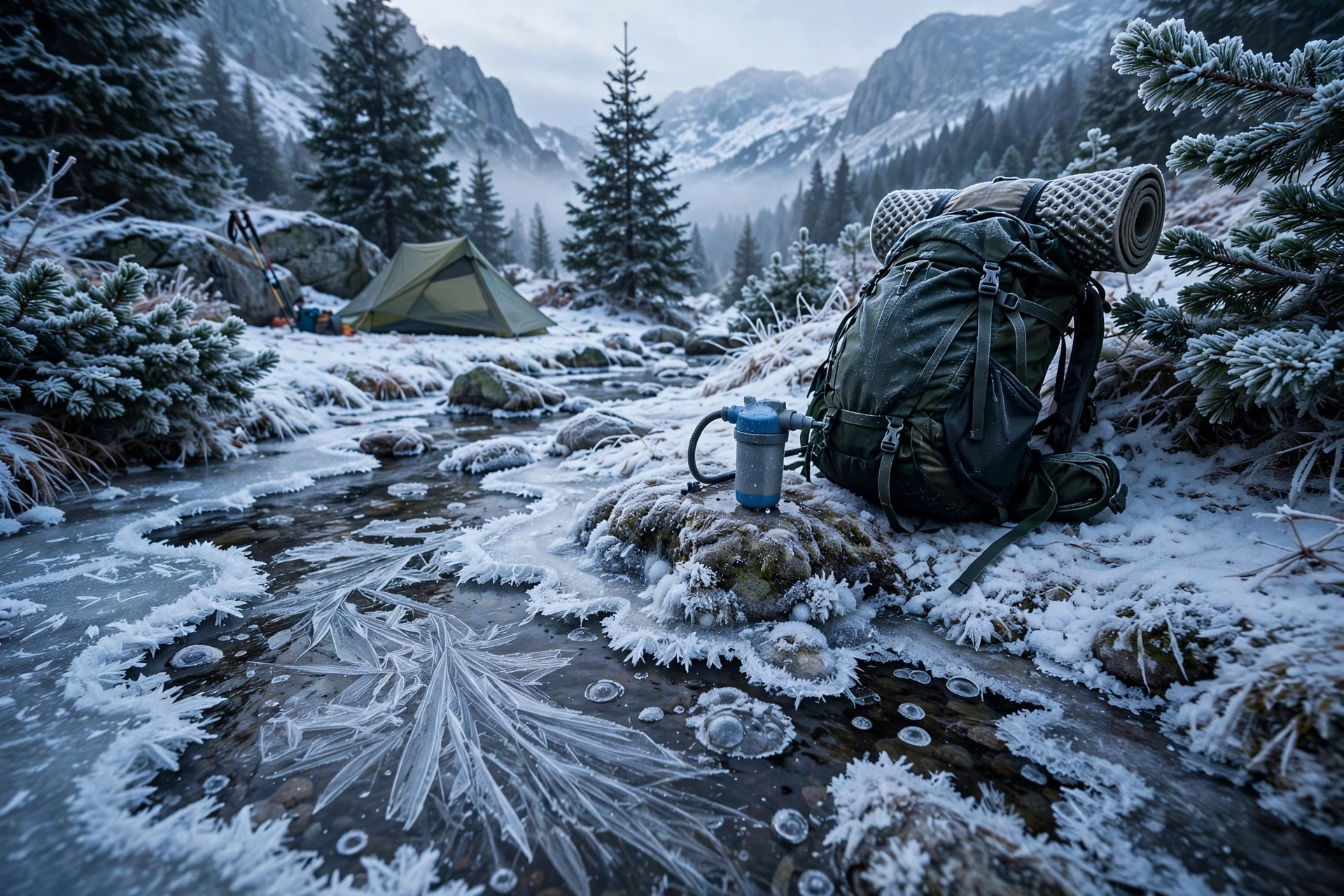
Winter backpacking has a silent gear killer, and it isn’t your boots or your stove. It’s your water filter. Most backpacking filters use hollow-fiber membranes — thousands of microscopic tubes that physically block bacteria and protozoa. When water trapped inside those fibers freezes, the ice expands and cracks them. The damage is invisible, irreversible, and a single freeze is enough. Seasoned winter backpackers list a frozen filter among the top winter backpacking mistakes for exactly this reason: you drink from it, confident you’re protected, and you’re not.
Quick answer: Once a filter is wet in freezing weather, treat it like a small animal you must keep warm. By day, carry it in an inside jacket or mid-layer pocket against your body — never in a pack lid or hip-belt pocket. At night, seal it in a zip-top bag and sleep with it in your sleeping bag’s footbox. Filter during the warmest part of the day, and carry a cold-weather backup (chemical treatment or the ability to boil). If it ever freezes solid, retire it.
A note on sources: This guide is research-compiled from manufacturer guidance (notably Sawyer’s explicit “do not freeze” warnings for hollow-fiber filters), winter-backpacking field guides, and widely repeated cold-weather practices. It is not a lab-tested equipment review.
Why freezing kills hollow-fiber filters
Understanding the “why” makes the rules stick. A hollow-fiber filter like the Sawyer Squeeze, Katadyn BeFree, or LifeStraw forces water through fiber walls with pores around 0.1–0.2 microns — small enough to stop E. coli, Giardia, and Cryptosporidium. Water expands about 9% when it freezes. Inside a fiber thinner than a hair, that expansion has nowhere to go, so it cracks the fiber wall. The cracks are larger than the pores the filter was engineered for, and they’re microscopic — the filter looks, feels, and flows exactly like it did before. No discoloration, no warning, no slower flow to tip you off.
That invisibility is what makes a frozen filter dangerous rather than merely broken. A snapped tent pole announces itself. A cracked filter smiles at you and keeps flowing.
This is also why the rule is absolute for standard filters: not “avoid deep freezes” but “don’t let a wet filter freeze.” The water volume inside a filter is tiny, so it can freeze solid in minutes of exposure at 32°F (0°C) — long before the water bottle in your pack shows ice. A few manufacturers do make exceptions (more on those below), but for the filters most hikers carry, one hard freeze means replacement.
Rule 1: The filter sleeps with you
The most common way filters die is also the most avoidable: the hiker filters water at dinner, tosses the damp filter into a pack pocket or the tent vestibule, and crawls into a warm bag. At 2 AM, when the temperature bottoms out, the filter freezes. Morning arrives, the hiker is thirsty, and the only safe-looking water treatment option is already ruined.
The fix is simple and non-negotiable: your wet filter goes in your sleeping bag every night. Seal it in a zip-top bag first — a damp filter against down or synthetic insulation all night is its own problem, adding moisture you spent money to keep out. Then tuck it in the footbox, where it won’t bother you.
Some backpackers prefer the inside of their puffy jacket, worn or laid inside the bag. Either works. What doesn’t work: the tent vestibule, the pack’s brain, a hip-belt pocket, or “inside the tent but on the floor.” If it’s not sharing your body heat, assume it freezes.
Rule 2: Body heat by day
Daytime takes more discipline because it’s inconvenient. The natural instinct is to drop the filter wherever it’s handy — and in freezing weather, “handy” usually means somewhere cold. Keep it inside your insulation, not outside it:
- Best: an inside chest pocket of your mid-layer or shell, against your base layer. It stays at body temperature all day and costs you nothing.
- Good: a zip-top bag tucked in the front of your pants or a neck pouch under your layers.
- Risky: hip-belt pockets, shoulder-strap pouches, pack lids, and side water-bottle pockets. These all sit outside your insulation and freeze in real winter conditions.
- Also risky: hydration-bladder inline filters and their hoses. The tube is the first thing to freeze — if you use an inline setup in winter, blow water back into the reservoir after every sip and keep the filter itself under your jacket.
The practical rhythm: filter water, immediately pocket the filter warm-side. It adds maybe ten seconds and becomes automatic after a trip or two.
Filtering technique in freezing temperatures
When you filter matters as much as where you store the filter. A few field-tested adjustments:
- Filter at midday. Water sources are at their warmest and least icy, your hands work better, and any drips on the filter have hours of above-freezing daylight to evaporate before the night chill. Filtering at a frosty 5 PM campsite is how filters get wet right before the coldest hours.
- Break the ice, don’t fight it. On partially frozen streams, break through to flowing water rather than scooping slush — less ice in your collection means a warmer, cleaner fill, and your filter works less hard. Carry a tent stake or use a trekking pole tip to crack thin ice.
- Dry what you can. After filtering, shake the filter out thoroughly and, if your setup allows it, blow air through it to push residual water out of the fibers. Less retained water means less ice expansion risk during the short carry back to your warm pocket. (This reduces risk; it does not make a cold-stored filter safe.)
- Keep hoses and dirty reservoirs warm too. A frozen hose on a gravity setup or a cracked squeeze pouch ends the filtering session just as thoroughly. Store pouches and hoses with the filter — inside your layers, not dangling off the pack.
For more on choosing the right filter in the first place, see our Sawyer Squeeze vs. Katadyn BeFree comparison.
Filters and purifiers built to survive freezing
If you hike in sub-freezing temperatures often, babysitting a hollow-fiber filter gets old — and one lapse still ruins it. A few products are engineered differently and are widely reported to tolerate freeze-thaw cycles:
- MSR Guardian purifier — a pump-style purifier (also removes viruses) whose membrane construction and internal clearances are designed to survive freezing. It’s heavy (~1 lb) and expensive, but it’s the standard answer for winter and expedition use.
- RapidPure filters — use an electroadsorptive media rather than plain hollow fibers, and are reported to rebound after freezing a limited number of times.
- Grayl GeoPress / UltraPress — press-style purifiers whose construction handles freezing better than typical hollow-fiber cartridges, making them a popular shoulder-season pick.
Two honest caveats. First, “freeze-tolerant” is not “freeze-proof” — repeated hard freezes still stress any device, and manufacturer guidance for your specific model wins over any general claim. Second, these are purifiers and premium filters at premium prices; for most three-season hikers who only occasionally dip below freezing, the body-heat rules above are the free, weightless solution. Match the tool to how often you actually hike in the cold.
Cold-weather backup plans
Even with perfect habits, winter is the season to carry a second way to make water safe. Conditions change, filters get dropped in snow, and backup weight is cheap insurance:
- Chemical treatment (chlorine dioxide). Drops and tablets work in the cold, but the chemistry slows dramatically — cold, cloudy water can require up to 4 hours of contact time for full effectiveness against hardy organisms like Cryptosporidium, versus 15–30 minutes in warm, clear water. Read your product’s cold-weather instructions and plan ahead; start treatment long before you’re thirsty. They also weigh almost nothing, which is why they’re the most popular backup.
- Boiling. The most reliable cold-weather backup: a rolling boil kills everything a filter would stop, and it doubles as a way to warm yourself and melt snow. The cost is fuel — melting snow for water is notoriously fuel-hungry, so carry more than your summer estimate.
- UV pens. Effective against the same organisms, but batteries lose capacity fast in the cold — keep the device (like your filter) in a warm pocket and carry spare batteries warm too.
And don’t forget the other half of winter water: your supply itself. Bottles freeze from the top down, so store them upside down (ice forms away from the cap) and consider an insulated sleeve for your main bottle. Planning how much to carry still matters in winter — cold suppresses thirst while dry air and exertion keep draining you, so review your water-carry planning before the trip and add it to your winter day-hike checklist.
What to do if your filter already froze
Be honest with yourself: if the filter was wet and the temperature dropped below freezing while it was out of your warmth — it froze. Don’t rationalize (“it was only a little below freezing,” “it was just for an hour”). The damage is invisible, so “it seems fine” is exactly what a ruined filter looks like.
Retire it and replace it. For the rest of that trip, switch to your backup: chemicals or boiling. Some hikers mark a suspect filter and demote it to non-critical use (watering plants, rinsing gear), which is a reasonable way to avoid waste — but never trust it for drinking water again.
The winter filter checklist
Tape this to your brain for every sub-freezing trip:
- Before the trip: confirm your filter has never frozen; pack a zip-top bag for it and a backup treatment method.
- At the trailhead: move the filter to an inside pocket. It never rides in the pack in winter.
- At water sources: filter midday when possible; shake and blow out residual water; warm-pocket the filter immediately.
- At camp: filter before dark; seal the damp filter in the zip-top bag; footbox of the sleeping bag, every night, no exceptions.
- If in doubt: retire it. A $30 replacement is cheaper than a waterborne illness miles from the trailhead.
A frozen filter is one of the few gear failures that is 100% preventable with habits that cost nothing and weigh nothing. Keep it warm, and it’ll keep you drinking safely all winter.
Related guides
Frequently asked questions
Can a water filter freeze and still be safe to use?
No — not if it’s a standard hollow-fiber filter (Sawyer Squeeze/Mini, Katadyn BeFree, LifeStraw, most gravity systems). Freezing water expands inside the microscopic fibers and cracks them, and that damage is invisible. After a single hard freeze, the filter can pass bacteria and protozoa it used to block. Replace it.
What temperature will damage a backpacking water filter?
Once the filter’s internal water drops to 32°F / 0°C and stays there long enough to freeze, damage can occur — and even brief dips near freezing are a gamble because the small water volume inside a filter freezes fast. Manufacturer guidance (e.g., Sawyer) is blunt: do not let a wet filter freeze, period. Treat anything near or below freezing as filter-danger weather.
Where should I keep my water filter at night in winter?
Inside your sleeping bag — sealed in a zip-top bag to keep moisture off your insulation, tucked in the footbox. Never leave it in your pack, the tent vestibule, or a side pocket overnight. A filter left out in 20°F air will freeze solid while you sleep, and you’ll discover it at the worst possible moment: morning, when you’re thirsty.
Are there water filters that survive freezing?
A few are engineered for it. The MSR Guardian purifier and RapidPure filters are widely reported to tolerate freeze-thaw cycles because of their membrane construction and extra internal space — and Grayl’s press-style purifiers are also considered freeze-friendly. If you backpack in sub-freezing weather regularly, a freeze-tolerant purifier is the most reliable upgrade.
Can I still use chemical treatment in cold weather?
Yes, but cold water makes chemicals work slower. Chlorine dioxide drops and tablets need significantly more contact time near freezing — commonly up to 4 hours for full effectiveness against Cryptosporidium in very cold, cloudy water, versus 15–30 minutes in warm clear water. Always read your specific product’s cold-weather instructions; in deep cold, boiling is the most reliable backup.