
Trekking Pole Sizing Chart by Height (2026 Fit Guide)
Find your correct trekking pole length with our height chart and 0.68 sizing formula — plus the 90-degree elbow test and uphill/downhill adjustments.
In this guide
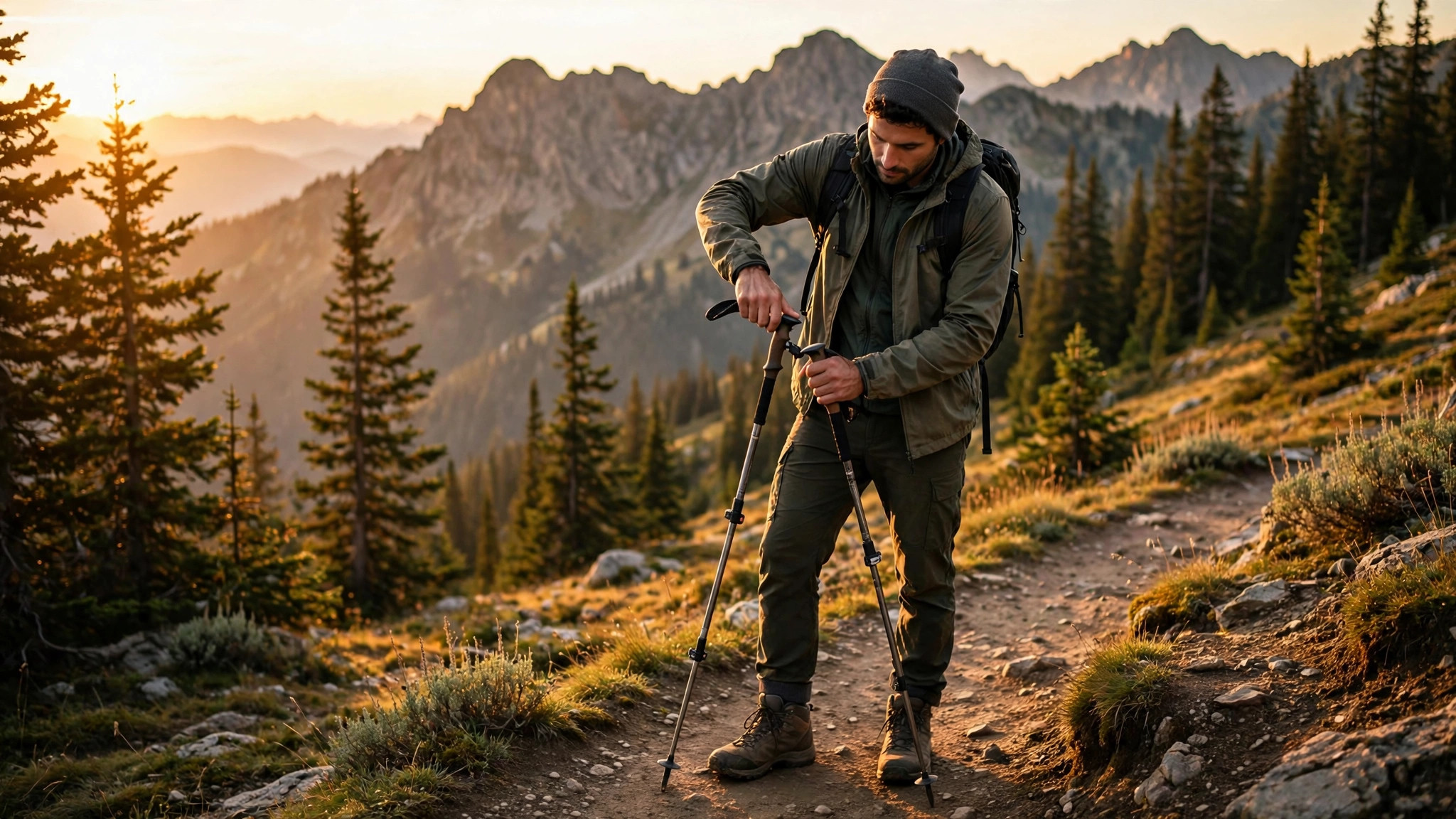
Your correct trekking pole length is the one that puts your elbows at roughly 90 degrees when the tips touch flat ground beside your boots. As a shortcut, multiply your height in centimeters by 0.68 — a 5'9" (175 cm) hiker gets about 119 cm, so 120 cm on the dial. The full height chart below gives the right band for every height, plus how to adjust for climbs, descents, and fixed-length poles.
Most pole-length advice stops at “just set them to 90 degrees,” which is true but useless in a store or online checkout. This guide gives you the chart to buy with, the formula to memorize, and the on-trail test that settles it — so your poles protect your knees instead of wrecking your shoulders.
In this guide
- Trekking pole length chart by height
- The 90-degree elbow test
- The 0.68 formula
- How to adjust poles for hills
- Adjustable vs fixed-length poles
- Sizing mistakes that cause pain
- FAQ
Trekking pole length chart by height
This table blends the fixed-length bands published by REI (100/110/120/130 cm) with the finer 5 cm steps most adjustable poles actually offer. Find your height and read your flat-ground starting length. Inch and centimeter values are both listed because US hikers buy in centimeters anyway — poles are a metric product.
| Your height | Suggested pole length |
|---|---|
| 4'5"–4'9" (135–145 cm) | 95–100 cm (37–39 in) |
| 4'10"–5'1" (147–155 cm) | 100–105 cm (39–41 in) |
| 5'2"–5'5" (157–165 cm) | 105–110 cm (41–43 in) |
| 5'6"–5'7" (168–170 cm) | 110–115 cm (43–45 in) |
| 5'8"–5'9" (173–175 cm) | 115–120 cm (45–47 in) |
| 5'10"–5'11" (178–180 cm) | 120–125 cm (47–49 in) |
| 6'0"–6'3" (183–190 cm) | 125–130 cm (49–51 in) |
| 6'4"+ (193 cm+) | 130–135 cm (51–53 in) |
Treat the chart as a starting point, not a verdict. Arm length, torso proportion, and pack weight all shift your ideal number a few centimeters. The elbow test in the next section is the final authority.
A note for shorter hikers: most mainstream adjustable poles bottom out at 100–105 cm. If your number is 100 cm or less (roughly 4'11" and under), check that the pole’s published minimum actually reaches your number — our trekking poles for short hikers guide covers models that size down properly.
The 90-degree elbow test
This is the fit check every outfitter uses, and it takes thirty seconds:
- Stand on flat ground in your hiking shoes, poles in hand.
- Let your arms hang naturally, plant both pole tips on the ground a few inches beside your boots.
- Relax your shoulders — don’t shrug, don’t hunch — and grip the handles as if you were walking.
- Check the angle at your elbows. 90 degrees is correct. A little over (100°) is fine; wildly off is not.
Read the result like a diagnosis:
- Elbows pinched tight (under 80°): poles too long. Shorten in 5 cm steps until the angle opens.
- Shoulders shrug toward your ears: poles too short. Lengthen until your shoulders drop.
- Correct angle but neck tension after 20 minutes: your arms are fighting the straps, not the length — learn the strap technique below before resizing.
Do this test on flat ground. Side slopes, stairs, and curbs all tilt the reading. If you’re sizing at home, a hallway works fine — what matters is level ground under your feet, not wilderness.
Strap technique changes your effective length
Thread your hand up through the strap from below so it sits across your palm and you grip handle and strap together. The strap carries your push, your grip stays relaxed, and you can effectively use a pole 2–3 cm shorter. Hand stabbed down through the top loses power and makes a correct-length pole feel “too short.”
The 0.68 formula
When there’s no chart handy — on the trail, in a gear swap, renting poles at a hut — use the formula: pole length (cm) = your height in cm × 0.68.
- 5'2" (157 cm) → ~107 cm
- 5'6" (168 cm) → ~114 cm
- 5'10" (178 cm) → ~121 cm
- 6'2" (188 cm) → ~128 cm
The 0.68 factor is the standard figure published by sizing guides and the height calculators hikers actually use; independent calculators land within a centimeter or two of it. Round to the nearest 5 cm for adjustable poles. It’s a starting point — still confirm with the elbow test when you can.
How to adjust poles for hills
Flat-ground length is your baseline, not your whole hike. Adjust at every terrain change; it takes five seconds with lever locks and it’s the difference between poles that help and poles that just hang there.
Steep climbs — shorten 5–10 cm. Planting at full length on a climb forces your shoulders up and wastes the push. Shorter poles let you drive off the grips. Some hikers “choke down” instead: slide your hand below the grip onto the shaft for quick pitches without touching the locks.
Steep descents — lengthen 5–10 cm. Longer poles let you plant ahead of your feet and brake with your arms, which is exactly the knee relief bad-knee hikers buy poles for in the first place. If your poles top out before your descent number (common for hikers over 6'2" on standard 130 cm poles), choose a pole with a 135+ cm maximum.
Traverses and side slopes — stagger them. Lengthen the downhill-side pole a few centimeters and shorten the uphill-side one. It keeps your torso upright instead of leaning into the slope.
Snowshoeing and deep snow — lengthen 5–10 cm beyond your flat-ground setting, because the baskets ride on the snow surface and the effective tip is higher. Use your snow baskets.
Trekking-pole tents — set to shelter spec. Most trekking-pole tents pitch at 110–135 cm, so check that your ideal pole length overlaps your tent’s required length before a trip, not at the campsite.
Adjustable vs fixed-length poles
Adjustable poles (telescoping or folding) cover a range — typically 100–135 cm for telescoping, or a fixed window like 95–110 cm for folding models. Buy by the range, not the average: your flat-ground number plus your ±10 cm terrain adjustments all have to fit inside it. A 6'3" hiker whose descent length is 135 cm needs a pole that tops out at 135+, not 130.
Fixed-length poles are sold by height bands (the REI chart above is built for them). They save weight and have no locks to slip, but you give up terrain adjustment — on steep descents you’ll choke down the grip or accept a suboptimal length. And don’t confuse collapsed length with sizing: folding poles pack down tiny, but only their usable range matters for fit.
Sizing mistakes that cause pain
- Setting poles once in the parking lot. The most common mistake. A pole set perfectly for flat trail is 10 cm too short on descents and 10 cm too long on climbs. Adjust or lose the benefit.
- Buying the average instead of the range. Two 120 cm-max poles are useless to a tall hiker on descents. Check both ends of the range.
- Trusting “one size fits all” marketing. Poles marketed this way usually span 105–130 cm, which quietly excludes the shortest and tallest 10% of hikers.
- Sizing in hiking shoes, then wearing heavier boots. Sole thickness changes your standing height. Size in the footwear you’ll actually hike in.
- Blaming the poles for strap problems. Neck and shoulder pain is usually strap technique (see above), not length. Fix the straps first, resize second.
FAQ
How do I know what trekking pole length is right for my height? Stand on flat ground with the pole tips beside your boots: your elbows should bend at about 90 degrees. As a shortcut, multiply your height in centimeters by 0.68 — a 175 cm hiker lands at ~119 cm, or about 120 cm. The height chart in this guide gives the exact band for every height.
Should my trekking poles be longer for steep downhill hiking than on flat trails? Yes — lengthen each pole 5 to 10 cm before steep descents and plant them ahead of your feet to brake the load on your knees. Shorten them 5 to 10 cm on steep climbs so you can push off without raising your shoulders. Reset to your flat-ground length on level trail.
Do adjustable trekking poles need sizing, or can I just guess a length? They still need sizing. Adjustment range is not infinite — most poles span 100 to 135 cm, which is too long for hikers under about 5'1" and too short for very tall hikers on descents. Check that your ideal number falls inside the pole’s published range before buying.
What trekking pole length should kids use, and can they share adult poles? Size kids with the same 90-degree elbow rule: most children need 80 to 100 cm, so look for poles with a short minimum like 66 cm. Sharing adult poles works only if the minimum length reaches their number; many adult poles bottom out at 100 cm and are too long for children.
Is the 90-degree elbow test reliable, or should I trust my height chart more? Trust the elbow test over the chart. Two hikers at the same height can have different arm and torso proportions, so the chart is a starting point and your body’s angle is the verdict. If your elbows pinch tight the poles are too long; if your shoulders shrug, they’re too short.
Related guides
- Trekking Poles for Short Hikers — the poles cluster sibling: models that size down below 100 cm
- Trekking Poles for Bad Knees — knee-friendly picks with downhill technique
- 10 Essentials Hiking Checklist — where poles fit into your core kit
Research-compiled guide: sizing figures cross-checked against REI’s published bands and independent pole calculators, October 2026. No manufacturer paid for placement; Trail Tested is reader-supported — learn how we rate gear.
Frequently asked questions
How do I know what trekking pole length is right for my height?
Stand on flat ground with the pole tips beside your boots: your elbows should bend at about 90 degrees. As a shortcut, multiply your height in centimeters by 0.68 — a 175 cm hiker lands at ~119 cm, or about 120 cm. The height chart in this guide gives the exact band for every height.
Should my trekking poles be longer for steep downhill hiking than on flat trails?
Yes — lengthen each pole 5 to 10 cm before steep descents and plant them ahead of your feet to brake the load on your knees. Shorten them 5 to 10 cm on steep climbs so you can push off without raising your shoulders. Reset to your flat-ground length on level trail.
Do adjustable trekking poles need sizing, or can I just guess a length?
They still need sizing. Adjustment range is not infinite — most poles span 100 to 135 cm, which is too long for hikers under about 5'1" and too short for very tall hikers on descents. Check that your ideal number falls inside the pole’s published range before buying.
What trekking pole length should kids use, and can they share adult poles?
Size kids with the same 90-degree elbow rule: most children need 80 to 100 cm, so look for poles with a short minimum like 66 cm. Sharing adult poles works only if the minimum length reaches their number; many adult poles bottom out at 100 cm and are too long for children.
Is the 90-degree elbow test reliable, or should I trust my height chart more?
Trust the elbow test over the chart. Two hikers at the same height can have different arm and torso proportions, so the chart is a starting point and your body’s angle is the verdict. If your elbows pinch tight the poles are too long; if your shoulders shrug, they’re too short.