Daypack & Backpack Torso Fit Database: Every Major Brand's Sizing in One Place (2026)
Stop guessing your pack size. Compare torso-fit ranges from Osprey, Gregory, Deuter, REI Co-op, Mystery Ranch, and Granite Gear in one searchable database — plus how to measure your torso correctly.
In this guide
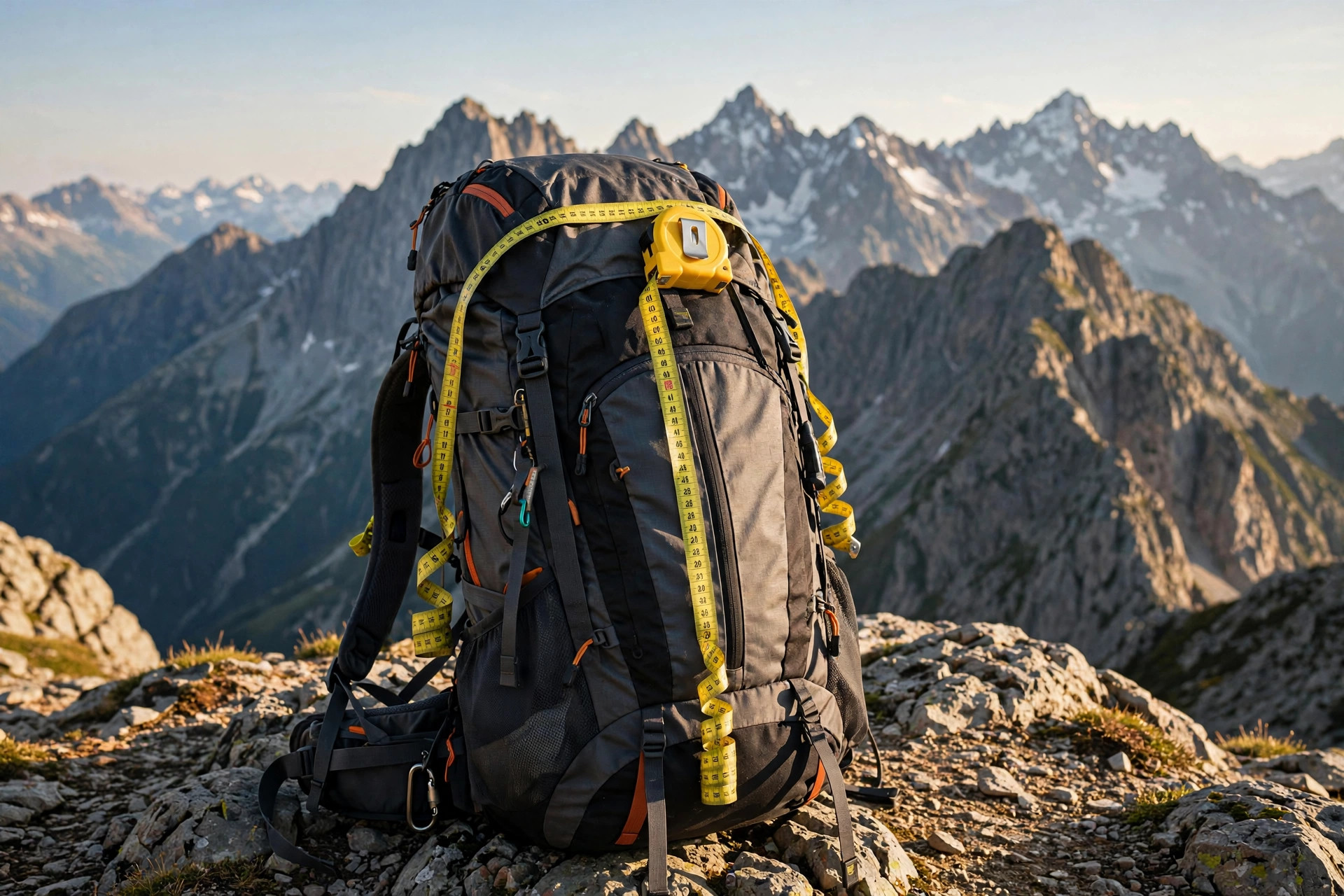
Here’s a problem every pack buyer hits: you measure your torso, open six browser tabs, and discover that an 18-inch torso is a “Medium” at one brand, a “Small/Medium” at another, and falls in a gap at a third. No two brands publish their sizing the same way — and until now, nobody had put them side by side.
Quick answer: This database unifies the published torso-fit ranges of six major pack brands — Osprey, Gregory, Deuter, REI Co-op, Mystery Ranch, and Granite Gear — so you can look up your torso measurement once and see your size at every brand. Measure from your C7 vertebra (bony bump at the base of your neck) to your iliac crest (top of hip bones), find your number in the tables below, and always verify against the exact pack’s product page before buying.
This is a free reference compiled from manufacturer-published size charts (October 2026). Brands update charts when lines are redesigned — use this as your starting filter, not your final word.
How to measure your torso (60 seconds)
- Find your C7. Tilt your head forward — the bony bump at the base of your neck where it meets your shoulders is your C7 vertebra.
- Find your iliac crest. Put your hands on your hips — the shelf-like top of your hip bones is the iliac crest.
- Measure. Have a friend run a tape measure down your spine from C7 to the iliac crest line, following your spine’s curve. Stand naturally — don’t crane.
- Write it down. Torso length has almost nothing to do with height. Two hikers who are both 5'10" can easily measure 17" and 21".
The database: torso ranges by brand
Osprey
Osprey uses the most granular sizing in the industry — and it varies by pack family, so check your specific model.
| Pack family | Men’s sizes (torso) | Women’s sizes (torso) |
|---|---|---|
| Expedition (Aether/Ariel) | S: 16–18", S/M: 18–20", M/L: 20–22", L: 22–24" | XS: 14–16", S: 16–18", S/M: 18–20", M: 20–22" |
| Ultralight (Exos/Eja, Levity/Lumina) | S: 16–18", S/M: 18–20", M/L: 20–22", L: 22–24" | XS: 14–16", S: 16–18", S/M: 18–20" |
| Daypacks (Talon/Tempest, Stratos/Sirrus, Kestrel/Kyte) | S/M: 16–20", M/L: 18–23" (adjustable within range) | XS/S: 13–17", S/M: 16–20" |
| Travel (Farpoint/Fairview) | S/M: 16–20", M/L: 18–23" | XS/S: 13–17", S/M: 16–20" |
Notes: Most Osprey daypacks (Talon, Tempest, Stratos, Kestrel) use an adjustable torso within the S/M or M/L range rather than fixed sizes. Expedition packs add interchangeable harnesses for fine-tuning. When between sizes, Osprey advises sizing down.
Gregory
Gregory’s newer packs use S/M and M/L splits; expedition packs (Baltoro/Deva) use S/M/L.
| Pack family | Men’s sizes (torso) | Women’s sizes (torso) |
|---|---|---|
| Expedition (Baltoro) | S: 16–19", M: 17–20", L: 18–21" | (Deva) S: 15–18", M: 17–20", L: 18–21" |
| All-rounder (Paragon/Amber) | S/M: 15–19", M/L: 18–22" | XS/S: 13–17", S/M: 16–20" |
| Lightweight (Maven/Jade) | S/M: 15–19", M/L: 18–22" | XS/S: 13–17", S/M: 16–20" |
Notes: Gregory’s FreeFloat suspension auto-adjusts somewhat, but torso size still determines the frame. The Baltoro/Deva’s three-size system (S/M/L) gives finer granularity than the two-size packs. Gregory’s women’s XS/S starts at 13" — one of the shortest ranges available, good for petite hikers.
Deuter
Deuter takes a different approach: most packs use an adjustable back-length system rather than fixed sizes.
| System | Torso fit | Found on |
|---|---|---|
| VariQuick | Adjustable ~15–21" (varies by model) | Futura, Aircontact Core, Trail series |
| VariFlex | Pivoting hip fins + adjustable back | Futura Pro, Aircontact Pro |
| Women’s SL | Shorter back, narrower straps (adjustable) | All women’s SL models |
Notes: Deuter’s philosophy is “one pack, dialed to you” — the VariQuick system slides the harness along the back panel to match your torso. This makes Deuter one of the easiest brands to fit if you’re between sizes. Check the specific model’s adjustment range on its product page.
REI Co-op
REI’s in-house packs follow a straightforward four-size system.
| Pack line | Sizes (torso) |
|---|---|
| Flash / Traverse / Trailbreak (men’s/unisex) | XS: 14–17", S: 16–19", M: 18–21", L: 20–23" |
| Flash / Traverse (women’s) | XS: 13–16", S: 15–18", M: 17–20", L: 19–22" |
Notes: REI’s ranges overlap generously between sizes — if you’re at a boundary, the adjustable torso on most models covers the gap. REI’s return policy (one year) makes fit experimentation low-risk.
Mystery Ranch
Mystery Ranch sizes by “yoke” — their term for the shoulder-harness assembly — matched to torso length.
| Yoke size | Torso range |
|---|---|
| XS | 14–17" |
| S | 16–19" |
| M | 18–21" |
| L | 20–23" |
Notes: Mystery Ranch’s yokes are swappable on many packs, so you can fine-tune fit after purchase. Their sizing runs true to the chart — measure carefully, as the ranges overlap less than REI’s.
Granite Gear
Granite Gear keeps it simple with three torso lengths.
| Torso size | Range |
|---|---|
| Short | 14–17" |
| Regular | 18–21" |
| Tall | 20–23" |
Notes: The simplest system here — three buckets, minimal overlap. If you’re at 17.5" or 21.5" (in the gaps), Granite Gear’s adjustable hip belt and harness give some forgiveness, but trying the pack loaded is wise.
Quick-lookup: “I measure X — what’s my size?”
| Your torso | Osprey (daypack) | Gregory | Deuter | REI Co-op | Mystery Ranch | Granite Gear |
|---|---|---|---|---|---|---|
| 15" | S/M | S/M | Adjust to fit | S | XS | Short |
| 16" | S/M | S/M | Adjust to fit | S | XS/S | Short |
| 17" | S/M | S/M | Adjust to fit | S/M | S | Short |
| 18" | S/M | S/M | Adjust to fit | M | S/M | Regular |
| 19" | S/M | S/M | Adjust to fit | M | M | Regular |
| 20" | M/L | M/L | Adjust to fit | M/L | M | Regular |
| 21" | M/L | M/L | Adjust to fit | L | M/L | Regular |
| 22" | M/L | M/L | Adjust to fit | L | L | Tall |
Men’s/unisex shown; women’s packs generally run one size shorter — see brand tables above.
How to use this database
Step 1: Measure once. Get your torso number using the method above. This number never changes — it’s yours for every pack you’ll ever buy.
Step 2: Filter, don’t finalize. Use the tables to narrow each brand to one or two candidate sizes. This eliminates the “which of these four sizes am I?” paralysis.
Step 3: Verify on the product page. Open the exact pack’s page and check its specific chart — individual models sometimes differ from the brand’s general ranges (Osprey especially).
Step 4: Try it loaded. If possible, try the pack with 15–20 lbs in it. An empty pack always feels fine; fit problems show up under load. The hip belt should sit on your iliac crest with the shoulder straps just kissing your shoulders — about 80% of the weight on your hips.
Why torso fit matters more than liters
A 65L pack that fits wrong carries worse than a 50L pack that fits right. Wrong torso length means the hip belt rides on your stomach or your thighs instead of your hip bones — and your shoulders end up carrying weight they were never meant to. Shoulder pain, lower-back ache, and hot spots all trace back to torso mismatch more often than to pack quality. Five minutes with a tape measure prevents all of it.
FAQ
How do I measure my torso for a backpack? Tilt your head forward and find the bony bump at the base of your neck (your C7 vertebra). Put your hands on your hips to feel the top of your hip bones (iliac crest). Measure straight down your spine from C7 to the iliac crest line — that’s your torso length. It has nothing to do with your height; two 5'10" hikers can have 17" and 21" torsos.
What if I’m between sizes? Size down if you’re between. A slightly small pack with the hip belt riding correctly beats a large pack whose shoulder straps can’t tighten enough. Also check whether the pack has an adjustable torso — many do, which makes between-sizes a non-issue.
Do women’s packs fit differently or just smaller? Genuinely differently — not just scaled down. Women’s-specific packs typically have narrower shoulder straps set closer together, a shorter torso range, conical hip belts shaped for wider hips, and sternum straps positioned higher. If a unisex pack never feels right, try the women’s version.
Why do brands’ size charts disagree so much? Because there’s no industry standard — each brand defines its own size breaks and measures slightly differently. That’s exactly why this database exists: an 18" torso is “Medium” at one brand and “Small/Medium” at another. Always cross-check the specific pack’s product page before buying.
How often do brands change their size charts? Occasionally — usually when a pack line gets redesigned. The ranges above were compiled from each brand’s published charts in October 2026. Treat this database as your starting filter, then verify against the product page of the exact pack you’re buying.
Related guides
- Packs hub — every pack guide in one place
- Best Daypack for Short Torso — when your torso is under 17"
- Best Hiking Backpack for Short Torso (Women’s) — women’s-specific short-torso picks
- Best Daypack for Petite Women Under $100 — budget petite picks
- How to Pack a Backpack — fit it right, then pack it right
Found an error or a brand update? Tell us via the contact page — this database stays accurate because hikers report changes.
Frequently asked questions
How do I measure my torso for a backpack?
Tilt your head forward and find the bony bump at the base of your neck (your C7 vertebra). Put your hands on your hips to feel the top of your hip bones (iliac crest). Measure straight down your spine from C7 to the iliac crest line — that’s your torso length. It has nothing to do with your height; two 5'10" hikers can have 17" and 21" torsos.
What if I'm between sizes?
Size down if you’re between. A slightly small pack with the hip belt riding correctly beats a large pack whose shoulder straps can’t tighten enough. Also check whether the pack has an adjustable torso — many do, which makes between-sizes a non-issue.
Do women's packs fit differently or just smaller?
Genuinely differently — not just scaled down. Women’s-specific packs typically have narrower shoulder straps set closer together, a shorter torso range, conical hip belts shaped for wider hips, and sternum straps positioned higher. If a unisex pack never feels right, try the women’s version.
Why do brands' size charts disagree so much?
Because there’s no industry standard — each brand defines its own size breaks and measures slightly differently. That’s exactly why this database exists: an 18" torso is ‘Medium’ at one brand and ‘Small/Medium’ at another. Always cross-check the specific pack’s product page before buying.
How often do brands change their size charts?
Occasionally — usually when a pack line gets redesigned. The ranges below were compiled from each brand’s published charts in October 2026. Treat this database as your starting filter, then verify against the product page of the exact pack you’re buying.