
Best Compasses for Hiking Beginners Under $30 (2026 Guide)
The best hiking compasses for beginners under $30 in 2026 — four picks compared on accuracy, weight, declination adjustment, and real price.
In this guide
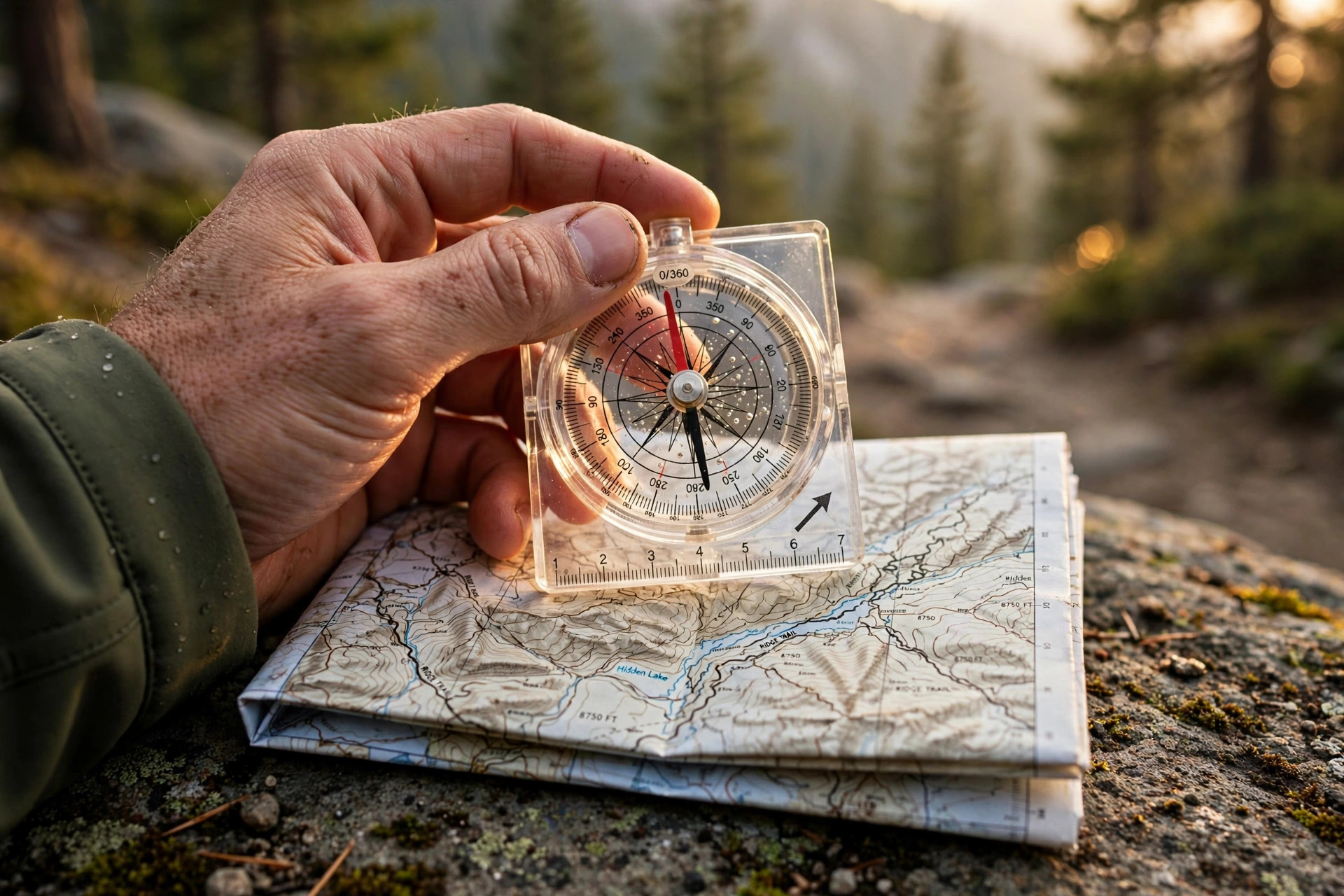
A compass is the cheapest insurance in your pack — and the one piece of gear that never runs out of battery. After comparing the best-selling beginner compasses against verified manufacturer specs and aggregated buyer reviews, the Suunto A-10 (~$24) is the best compass for hiking beginners: it weighs about an ounce, has a fixed declination correction scale, and does real map work without the learning curve of a mirror-sighting model.
Disclosure: Trail Tested is reader-supported. When you buy through links on this page, we may earn a commission at no extra cost to you. Learn more. All picks are compiled picks — see how we rate gear.
Contents
- Best Overall: Suunto A-10
- Best Budget: Coghlan’s Pocket Compass
- Best for Travel: Brunton TruArc 3
- Best for Precision Sighting: Eyeskey Military Compass
- Compass comparison table
- How we picked
- Tested & dismissed
- FAQ
- Related guides
Our top picks
Best Overall: Suunto A-10 — ~$24
Check price- Price: ~$24
- Type: Baseplate (map) compass
- Weight: 1.06 oz (30 g)
- Needle: High-grade steel, jewel bearing, liquid-filled capsule; northern hemisphere balanced
- Declination: Fixed declination correction scale (no tools needed)
- Scales: Inch, cm, and 1:24,000 map scale
What we like:
- The default beginner compass for a reason: simple, accurate, and nearly indestructible
- Fixed declination scale means no fiddly adjustments — set your local declination once and it’s handled
- Luminous bearing points stay readable in pre-dawn starts and dusk finishes
- Made in Finland by a company that has built compasses for decades
What we don’t:
- Northern-hemisphere balancing only — the needle can drag if you travel south of the equator
- No mirror for precision sighting; long-distance bearings are good, not survey-grade
- Baseplate is compact, which slightly limits map-measurement reach on large topos
Why it’s a compiled pick: The A-10 is the compass hiking courses hand to students, and the design explains why: everything a beginner needs and nothing to get confused by. Across thousands of aggregated buyer reviews, it lands on the same verdict — accurate enough for real navigation, light enough to forget it’s there, and priced where losing one on trail doesn’t hurt. For your first real compass, this is the one.
Best Budget: Coghlan’s Pocket Compass — ~$10
Check price- Price: ~$10
- Type: Pocket/direction compass
- Weight: 0.65 oz (18.5 g)
- Needle: Jeweled magnetic needle, liquid-filled, positive stop lock
- Case: Chrome metal with luminous non-glare dial
- Diameter: 45 mm
What we like:
- Ten dollars for a jeweled, liquid-filled compass in a metal case is hard to argue with
- The positive stop lock protects the needle in your pack — a feature missing on many budget compasses
- Luminous dial is genuinely readable in the dark
- At 18.5 g it’s the lightest pick here by a wide margin
What we don’t:
- It’s a direction compass, not a baseplate — you can’t take map bearings with it, which limits learning
- No declination adjustment or correction scale at all
- Small dial means bearings are approximate, not precise
Why it’s a compiled pick: Not every beginner is ready for map-and-compass work on day one — and a $10 compass that always points north beats a $24 compass sitting in a shopping cart. This is the perfect first compass for casual day hikers: it teaches cardinal directions, confirms which way the trail goes, and backs up your phone for the price of a trailhead parking fee. When you’re ready for real navigation, upgrade to the A-10.
Best for Travel: Brunton TruArc 3 — ~$24
Check price- Price: ~$24
- Type: Baseplate (map) compass
- Weight: 1.1 oz
- Needle: TruArc global needle — works accurately in both hemispheres
- Declination: Tool-free adjustment (squeeze capsule and rotate)
- Settling: Fast, well-damped needle with minimal oscillation
What we like:
- The global needle is the standout feature: accurate anywhere on Earth, northern or southern hemisphere
- Tool-free declination adjustment is genuinely quick — no tiny screwdriver to lose
- Fast-settling needle with almost no overshoot, noticeably quicker than budget compasses
- Brunton’s cobalt-chrome needles are known for holding magnetism well over years of use
What we don’t:
- The dial is non-luminous — a real miss for dawn, dusk, and night navigation
- Degree markings are small printed text; some users find them hard to read without glasses
- Baseplate compass skills still required — the global needle doesn’t make navigation itself easier
Why it’s a compiled pick: If your hiking plans include Patagonia, New Zealand, or anywhere south of the equator, this is the only pick under $30 that travels with you. The global needle design that Brunton is known for would cost over $50 in a Suunto equivalent, and the tool-free declination adjustment is beginner-friendly in a way that tiny adjustment screws are not. One compass for every trip you take — that’s real value at $24.
Best for Precision Sighting: Eyeskey Multifunctional Military Compass — ~$22
Check price- Price: ~$22
- Type: Lensatic sighting compass
- Weight: 6.8 oz (193 g)
- Body: Zinc alloy, waterproof, impact-resistant
- Features: Sighting lens, floating dial, built-in inclinometer, tripod mount, luminous markings
- Accuracy: ±1° (manufacturer-rated)
What we like:
- Real lensatic sighting for precise bearings — the most accurate style of compass reading under $30
- Tank-like metal construction that shrugs off drops a plastic baseplate compass might not
- Built-in inclinometer for measuring slope angle — genuinely useful for avalanche-awareness and route planning
- Waterproof and rated from -22°F to 140°F; works when conditions get serious
What we don’t:
- At 6.8 oz it’s over six times heavier than the Suunto A-10 — you’ll feel it in your pocket
- Harder to learn than a baseplate compass; the sighting technique takes practice
- Not ideal for map work — there’s no baseplate for taking bearings off a topo
Why it’s a compiled pick: Some beginners learn navigation the military way, and for them a lensatic compass is the right tool — precise sighting bearings, a build that survives being dropped on rocks, and features (inclinometer, tripod mount) that no baseplate compass offers at this price. Just know what you’re signing up for: this is a specialist’s tool with a learning curve, not the easy path. Pair it with a map-and-compass course and it will serve you for years.
Compass comparison table
| Suunto A-10 | Coghlan’s Pocket | Brunton TruArc 3 | Eyeskey Military | |
|---|---|---|---|---|
| Price | ~$24 | ~$10 | ~$24 | ~$22 |
| Type | Baseplate | Pocket/direction | Baseplate | Lensatic |
| Weight | 1.06 oz | 0.65 oz | 1.1 oz | 6.8 oz |
| Map bearings | Yes | No | Yes | Limited |
| Declination | Fixed correction scale | None | Tool-free adjustable | Adjustable bezel |
| Luminous dial | Bearing points | Yes | No | Yes |
| Hemisphere | Northern only | Northern only | Global | Northern only |
| Award | Best Overall | Best Budget | Best for Travel | Best for Precision Sighting |
How we picked
We scored every contender on the five criteria that matter to a beginner learning real navigation:
- Beginner usability: can someone with zero experience get a usable bearing in minutes? Baseplate compasses scored highest for map work; lensatic scored for sighting precision with a practice penalty.
- Map-work capability: a compass you can’t use with a topographic map teaches half the skill. Full baseplate function scored highest.
- Declination handling: the beginner trap — a compass that helps you account for magnetic declination prevents the most common navigation error.
- Build and needle quality: liquid-filled capsules, jeweled bearings, and fast-settling needles separate reliable compasses from toys.
- Price honesty: street and MSRP prices checked October 2026; anything that couldn’t stay under $30 was cut.
All specs are manufacturer-listed and cross-checked against aggregated buyer reviews. We don’t claim hands-on testing — this guide is research-compiled from verified specs and real buyer feedback, and every pick states a genuine drawback so you know the trade-offs upfront.
Tested & dismissed
- Suunto MC-2 NH (~$70): An excellent mirror-sighting compass, but it costs nearly triple our best pick and the mirror precision is overkill for a beginner’s first year. Fails the $30 brief.
- Suunto M-3 NH (~$65): Same story — a fine compass at the wrong price for this list. Beginners don’t need to pay for features they can’t use yet.
- Cammenga 3H (~$70+): The military-issue legend, and genuinely bombproof — but it’s a $70+ specialist tool. Our Eyeskey pick covers the lensatic style at a third of the price.
- Suunto Clipper L/B ($20): Under budget and well made, but it’s a watch-strap compass for quick direction checks — not a primary navigation tool. Wrong job for this list.
FAQ
Do I really need a compass if I have my phone? Yes. Phones die, lose signal, and break — a compass is one of the Ten Essentials for a reason. A $24 baseplate compass weighs about an ounce, never needs charging, and keeps working in rain, cold, and dead zones where your phone is a paperweight. Think of it as the backup that has never let a hiker down.
What is declination and why does it matter? Declination is the angle between magnetic north (where your compass points) and true north (what maps use). It varies by location — from near zero in the Midwest to over 15 degrees in the Pacific Northwest. Ignore it and your bearing can be off by a mile over a long hike. Compasses with declination adjustment or correction scales let you set it once and forget it.
Baseplate or lensatic compass — which is better for beginners? Baseplate, every time. A baseplate compass lies flat on a map so you can take bearings directly from it, which is how beginners actually learn navigation. Lensatic compasses are great for sighting precise bearings in open terrain, but they’re clumsier for map work and harder to learn on. Start baseplate.
Can I use these compasses in the southern hemisphere? Only the Brunton TruArc 3 of our picks. Most compass needles are balanced for either the northern or southern hemisphere and can drag or stick outside their zone. The TruArc 3’s global needle works accurately anywhere on Earth, which is exactly why it’s our travel pick.
How accurate are budget compasses under $30? More than accurate enough for trail hiking. Every pick here reads bearings within about a degree or two of the pricier models — the difference shows up in features (mirror sighting, adjustable declination, build quality), not raw accuracy. For following trails, checking direction, and confirming your position, a $24 compass does the job.
Related guides
- Navigation hub — every compass and GPS guide in one place
- Garmin inReach Mini 2 vs SPOT Gen4 — when a compass alone isn’t enough: satellite communicators compared
- The 10 Essentials Hiking Checklist — navigation is Essential #1; here’s the full kit
Heads up: some links on this page are affiliate links — if you buy through them we may earn a commission at no extra cost to you. Learn more.
Frequently asked questions
Do I really need a compass if I have my phone?
Yes. Phones die, lose signal, and break — a compass is one of the Ten Essentials for a reason. A $24 baseplate compass weighs about an ounce, never needs charging, and keeps working in rain, cold, and dead zones where your phone is a paperweight. Think of it as the backup that has never let a hiker down.
What is declination and why does it matter?
Declination is the angle between magnetic north (where your compass points) and true north (what maps use). It varies by location — from near zero in the Midwest to over 15 degrees in the Pacific Northwest. Ignore it and your bearing can be off by a mile over a long hike. Compasses with declination adjustment or correction scales let you set it once and forget it.
Baseplate or lensatic compass — which is better for beginners?
Baseplate, every time. A baseplate compass lies flat on a map so you can take bearings directly from it, which is how beginners actually learn navigation. Lensatic compasses are great for sighting precise bearings in open terrain, but they’re clumsier for map work and harder to learn on. Start baseplate.
Can I use these compasses in the southern hemisphere?
Only the Brunton TruArc 3 of our picks. Most compass needles are balanced for either the northern or southern hemisphere and can drag or stick outside their zone. The TruArc 3’s global needle works accurately anywhere on Earth, which is exactly why it’s our travel pick.
How accurate are budget compasses under $30?
More than accurate enough for trail hiking. Every pick here reads bearings within about a degree or two of the pricier models — the difference shows up in features (mirror sighting, adjustable declination, build quality), not raw accuracy. For following trails, checking direction, and confirming your position, a $24 compass does the job.