The 4 Best Hiking Sandals for River Crossings (2026)
Cross creeks without wrecking your boots. Compare the 4 best hiking sandals for river crossings — KEEN Newport H2, Chaco Z/Cloud, Teva Hurricane XLT2, Bedrock Cairn — for grip, drainage, and toe protection.
In this guide
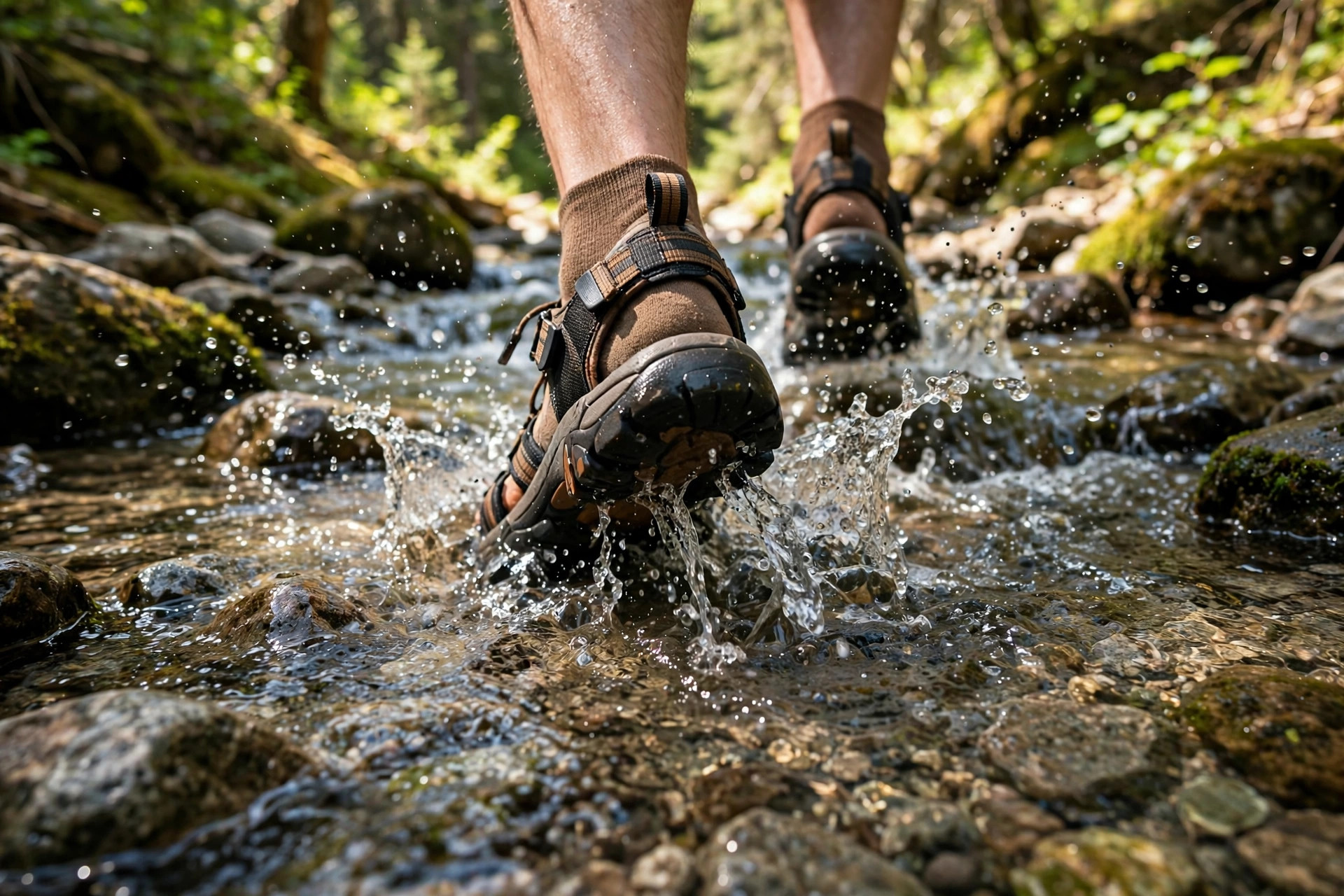
Every backpacker knows the moment: the trail dead-ends at a creek running fast and cold, and your choices are wade through in your boots (hello, all-day squelch and blisters) or go barefoot over invisible rocks (hello, stubbed toes and cuts). A pair of river-worthy hiking sandals solves it — they live on the outside of your pack, go on for the crossing, and drain dry in minutes.
Quick answer: The best hiking sandals for river crossings are the KEEN Newport H2 — closed-toe protection, grippy siped outsole, and a secure fit system that stays put in current. The Chaco Z/Cloud is the classic open-sandal alternative with legendary durability, the Teva Hurricane XLT2 is the budget-friendly workhorse, and the Bedrock Cairn Evo 3D Pro is the ultralight pick for ounce-counters. All four drain fast and grip wet rock.
Disclosure: Trail Tested is reader-supported. When you buy through links on this page, we may earn a commission at no extra cost to you. Learn more. All picks are compiled picks — see how we rate gear.
The 4 best hiking sandals for river crossings
1. KEEN Newport H2 — the best overall
KEEN Newport H2 at KEEN- Price: $125–$130
- Weight: ~15 oz per pair (men’s 9)
- Upper: Washable polyester webbing with closed-toe bumper
- Outsole: Non-marking rubber with razor-siped lugs for wet traction
- Fit: Bungee lacing with secure heel strap
- Notable: The original “cross the river” sandal; hydrophobic webbing dries fast; machine washable
Why it’s a compiled pick: The Newport H2 has owned this category for two decades for one reason: the closed-toe bumper. When you can’t see the riverbed, toe protection isn’t a luxury — it’s the difference between a clean crossing and a trip-ending injury. The siped outsole grips slick rock like few others, the bungee system lets you cinch a truly current-proof fit in seconds, and they double as camp shoes all summer. The weight penalty over lighter sandals is worth it the first time your foot finds a sharp rock.
2. Chaco Z/Cloud — the durable classic
Chaco Z/Cloud at Chaco- Price: $105
- Weight: ~14 oz per pair (men’s 9)
- Upper: Adjustable polyester webbing straps (no toe guard)
- Outsole: ChacoGrip rubber, 3mm lug depth
- Footbed: PU Z/Cloud cushioning
- Notable: Legendary durability — resoleable through Chaco’s repair program; the thru-hiker’s sandal
Why it’s a compiled pick: Chacos are the cockroaches of trail footwear — they survive thru-hikes that kill three pairs of trail runners. The Z/Cloud’s adjustable strap system locks your foot down securely for crossings, the cushioned PU footbed is comfortable for actual hiking miles (not just fords), and Chaco will resole them when the tread finally gives out. The open toe is the tradeoff: fine for sandy crossings, riskier on rocky rivers. Thousands of PCT and AT hikers can’t be wrong.
3. Teva Hurricane XLT2 — the budget workhorse
Teva Hurricane XLT2 at Sports Unlimited- Price: ~$80
- Weight: ~13 oz per pair (men’s 9)
- Upper: Quick-dry webbing with three adjustment points
- Outsole: Durabrasion rubber
- Footbed: EVA cushioning
- Notable: The cheapest reputable crossing sandal; hook-and-loop straps adjust in seconds even with cold wet hands
Why it’s a compiled pick: Not every river crossing justifies $130 sandals. The Hurricane XLT2 does the core job — stays on your feet, grips reasonably, drains fast — for about sixty percent of the KEEN’s price. The EVA footbed won’t last as many miles as Chaco’s PU, and the open toe shares the Chaco’s rock risk, but as a dedicated “lives on the pack, comes out for water” shoe, it’s the smart-money pick.
4. Bedrock Cairn Evo 3D Pro — the ultralight pick
Bedrock Cairn Evo 3D Pro at Bedrock- Price: $140
- Weight: ~11 oz per pair (men’s 9)
- Upper: Minimalist adjustable strapping (open toe)
- Outsole: Vibram with 3D-molded footbed
- Notable: The 3D Pro footbed is sculpted to your foot shape; packs nearly flat; beloved by ultralight backpackers
Why it’s a compiled pick: When every ounce matters, the Cairn is what serious ultralighters strap to their packs. The 3D-molded footbed grips the foot far better than flat minimalist sandals, so they stay put in current despite the minimal strapping, and they disappear against your pack the rest of the day. The price is steep for how little sandal there is — but you’re paying for the lightest credible river-crossing shoe that exists.
Spec comparison
| Sandal | Price | Weight (pair) | Toe protection | Best for |
|---|---|---|---|---|
| KEEN Newport H2 | $125–$130 | ~15 oz | Closed-toe bumper | Rocky rivers, max protection |
| Chaco Z/Cloud | $105 | ~14 oz | Open | Durability, long trail miles |
| Teva Hurricane XLT2 | ~$80 | ~13 oz | Open | Budget crossings |
| Bedrock Cairn Evo 3D Pro | $140 | ~11 oz | Open | Ultralight backpacking |
How to choose hiking sandals for river crossings
Toe protection is the first decision. Rocky, unfamiliar, or fast rivers: get the closed-toe KEEN. Sandy bottoms and familiar crossings: open sandals are fine and drain marginally faster.
Fit security matters more than cushioning. A sandal that floats off in current is useless. Look for a real heel strap (not a slide), multiple adjustment points, and a system you can tighten with cold, wet hands — bungees and hook-and-loop beat fiddly buckles.
Drainage is table stakes. All four picks here use hydrophobic webbing and open footbeds that shed water in minutes. Avoid anything with absorbent fabric linings or enclosed designs that hold water.
Think beyond the crossing. The best river sandals pull double duty as camp shoes — saving you from packing a second pair. The Newport H2 and Z/Cloud both handle evening camp miles comfortably.
River-crossing safety basics: unbuckle your hip belt before crossing (so you can ditch the pack if you fall), face upstream, shuffle sideways, use trekking poles or a stick for a third point of contact, and never cross water you can’t see the bottom of in fast current. If it looks sketchy, it is — wait, find another spot, or turn around.
FAQ
Should I wear sandals or just wade in my hiking shoes? Sandals win for most crossings. Wading in hiking shoes (especially leather or waterproof ones) means hiking the rest of the day in squelching, blister-causing wetness — waterproof membranes trap water in as effectively as they keep it out. Sandals drain in minutes and keep your main footwear dry in your pack.
Do I need toe protection for river crossings? Yes — this is the big one. Submerged rocks are invisible, slippery, and sharp. Closed-toe sandals like the KEEN Newport H2 protect against stubbed and cut toes. Open sandals like Chacos work fine in sandy or familiar crossings, but toe guards earn their weight on rocky rivers.
How do I keep sandals from slipping off in current? Snug heel straps are non-negotiable — that’s why sport sandals beat flip-flops. Cinch all straps before entering the water, and unbuckle your hip belt (standard river-crossing safety). In strong current, face upstream and shuffle sideways rather than stepping high.
Are hiking sandals good for hiking, or just crossings? The burly ones (Newport H2, Z/Cloud) handle miles of trail fine and many hikers wear them all summer. Ultralight options (Bedrock) are better as camp-and-crossing shoes. None match a real hiking shoe for ankle support on rough terrain.
How much do river-crossing sandals weigh? Typically 13–17 oz per pair — the KEEN Newport H2 is around 15 oz, Chaco Z/Cloud about 14 oz, Teva Hurricane XLT2 roughly 13 oz, and the Bedrock Cairn around 11 oz. Worth it on any route with more than one serious ford.
Related guides
- Feet & Footwear hub — every shoe and foot-problem guide in one place
- Best Hiking Shoes for Wide Feet (Men’s) — when your trail shoes need room too
- What to Wear Hiking in 50-Degree Weather — layering for cold, wet shoulder seasons
What’s your river-crossing system — dedicated sandals, or do you just commit to wet boots? Tell us via the contact page — crossing stories welcome.
Heads up: some links on this page are affiliate links — if you buy through them we may earn a commission at no extra cost to you. Learn more.
Frequently asked questions
Should I wear sandals or just wade in my hiking shoes?
Sandals win for most crossings. Wading in hiking shoes (especially leather or waterproof ones) means hiking the rest of the day in squelching, blister-causing wetness — waterproof membranes trap water in as effectively as they keep it out. Sandals drain in minutes and keep your main footwear dry in your pack.
Do I need toe protection for river crossings?
Yes — this is the big one. Submerged rocks are invisible, slippery, and sharp. Closed-toe sandals like the KEEN Newport H2 protect against stubbed and cut toes. Open sandals like Chacos work fine in sandy or familiar crossings, but toe guards earn their weight on rocky rivers.
How do I keep sandals from slipping off in current?
Snug heel straps are non-negotiable — that’s why sport sandals beat flip-flops. Cinch all straps before entering the water, and unbuckle your hip belt (standard river-crossing safety). In strong current, face upstream and shuffle sideways rather than stepping high.
Are hiking sandals good for hiking, or just crossings?
The burly ones (Newport H2, Z/Cloud) handle miles of trail fine and many hikers wear them all summer. Ultralight options (Bedrock) are better as camp-and-crossing shoes. None match a real hiking shoe for ankle support on rough terrain.
How much do river-crossing sandals weigh?
Typically 13–17 oz per pair — the KEEN Newport H2 is around 15 oz, Chaco Z/Cloud about 14 oz, Teva Hurricane XLT2 roughly 13 oz, and the Bedrock Cairn around 11 oz. Worth it on any route with more than one serious ford.